Key Terms
| Term | Definition | Exam Context/Example |
|---|---|---|
| Cryptographic Primitives | Fundamental cryptographic tools like RSA, AES, SHA-2, and SHA-3. | They provide the building blocks necessary to achieve secure communication in distributed systems such as e-commerce or secure messaging. |
| Communication Protocol | A distributed algorithm executed by two or more parties that specifies the syntax, semantics, and synchronisation of data exchanged between them. | If an algorithm is not distributed (i.e., only executed in one place), it is not called a protocol. |
| Security (or Cryptographic) Protocols | Communication protocols that employ cryptographic mechanisms (encryption, hashing, digital signatures) to achieve security goals. | They aim to solve issues like determining a message’s origin, preventing replays, and ensuring confidentiality, integrity, and non-repudiation (e.g., SSL/TLS, IPSec). |
| Dolev-Yao Adversary | An adversary who controls the network; they are able to eavesdrop on all messages, intercept/send modified messages under any sender name, construct new messages from available information, and compromise sufficiently old cryptographic keys. | This is the model often used to test the security of communication protocols. |
| Honest (Protocol Agents) | Agents who do not deviate from the protocol specification and whose cryptographic keys have not been compromised. | Protocol security properties must hold if participating agents (A, B, S) are honest. |
| Symbolic Encryption Notation {m}k | Notation for a message m that has been encrypted and authenticated with a symmetric key k. | Defined as , where are keys derived from . |
| Nonce (N) | A “number used once” that guarantees the freshness of a message. | Implemented as a random number; used to protect against replay attacks by being generated, sent, and then returned to show the message was freshly generated. |
| Replay Attack | An attack where an adversary intercepts and uses a message later (e.g., to authenticate themselves as the original sender). An adversary may store values from a previous session and replay them. | Can be prevented by requiring the message to be signed/authenticated to vary, often using timestamps or nonces. |
| Key Freshness | A required security property for key establishment protocols: the session key () is fresh (was not used before). | If an adversary stores and replays values from a previous session (Replay Attack), key freshness is not satisfied. |
| Key Secrecy | A required security property for key establishment protocols: the session key () is secret (not known to the adversary), assuming honest participants. | If a key is compromised, it should only affect that session, justifying the use of session keys. |
| Agreement (Key Property) | A required security property where parties A and B agree on the session key () and who the communicating parties are. | Attack 2 (Impersonation Attack) on key establishment protocols shows this property can be difficult to satisfy. |
| Master Keys | Long-lived, secret keys, typically keys of a public-key cryptosystem. | Used for the generation of session keys, and access to them is severely limited to prevent attacks. |
| Session Keys | Keys of the second level of security, associated with a session and only valid for the short time of the session’s duration. | Usually keys of a symmetric cryptosystem; if compromised, they affect only that session, increasing overall security. |
| Forward Secrecy | A key-exchange scheme that resists attacks where an adversary records session data, hoping to decrypt it later if the long-term secret key is compromised in the future. | Diffie–Hellman Key Agreement naturally provides forward secrecy as it does not encrypt a session key. |
| Diffie–Hellman Key Agreement | The first practical solution to the key distribution problem, based on public-key cryptography, enabling two parties who have never communicated to establish a mutual secret key over a public channel. | Its security relies on the Diffie–Hellman assumption—that computing from and is intractable. |
| Man-in-the-middle Attack (Middleperson Attack) | An attack where an active adversary (like a Dolev-Yao adversary) intercepts communications, establishing separate secret keys with both communicating parties and impersonating each one to the other. | This attack is effective against the passive Diffie–Hellman protocol. Also called the Mafia-in-the-middle attack in some contexts, especially when keys are reused across protocols. |
| Entity Authentication (Identification) | The process where one party (e.g., Alice) convinces her communication partner (Bob) that her identity in the current communication is as declared, thereby preventing impersonation. | This is achieved, for example, by Alice signing a specific message. |
| Mutual Entity Authentication | Guarantees the identity of both communicating parties in the current communication session. | Required in spontaneous key exchange protocols like Diffie-Hellman to address the lack of authenticity inherent in the base scheme. |
| Challenge-response Identification | A method where one party (Bob/Verifier) chooses a random number (challenge) and transmits it to the other (Alice/Prover), who includes it in a signed message (response) and returns it. | Bob checks the random number and signature to ensure the message is fresh and the identity is genuine. |
| Kerberos | A distributed authentication service and protocol providing entity authentication and key establishment using symmetric cryptography and a trusted third party (the Kerberos authentication server). | The protocol involves the trusted server providing the client with a ticket for server containing a session key. |
| Ticket (Kerberos) | Part of the credentials supplied by the Kerberos authentication server to client for server , encrypted with ‘s secret key (). | Contains ‘s identity and a copy of the session key () and is intended for ; forwards it to . |
| Authenticator (Kerberos) | Created by the client and encrypted with the session key (), it proves to the server that knows the session key embedded in the ticket. | In the simplified protocol, it contains ‘s identity and a timestamp (). |
| Certification Authority (CA) | An offline trusted third party used in public-key management; verifies entity authenticity and binds a public key to a distinguished name via a certificate. | Enables key storage and forwarding over insecure media, as everyone knows the CA’s public key to verify signatures. |
| Certificates | Documents signed by a Certification Authority (CA) that bind a public key to a distinguished name. | They typically contain the owner’s distinguished name, the owner’s public key, the CA’s name, a serial number, and a validity period. |
| Certificate revocation lists | A list of entries corresponding to revoked certificates, signed by the CA. | Maintained to publicize that a secret key has been compromised, as it is impossible to notify all users possessing copies of the certificate. |
| Interactive Proof System | A system where a prover (Peggy) and a verifier (Vic) communicate alternately to demonstrate knowledge of a secret fact (prover’s secret). | The interaction consists of moves, typically involving a challenge by Vic and a response by Peggy. |
| Knowledge Completeness | A requirement for interactive proof systems: If the prover knows the prover’s secret, then the verifier will always accept the proof. | If Alice knows the password in a simple password scheme, Vic accepts. |
| Knowledge Soundness | A requirement for interactive proof systems: If the prover can convince the verifier with reasonable probability, then she knows the prover’s secret. | In Fiat-Shamir identification, a cheating prover’s success probability is kept low ( per round) to ensure soundness. |
| Zero-Knowledge (Proof System) | An interactive proof system where the verifier, after interacting with the prover, obtains no knowledge that could not have been efficiently simulated without interaction. | This property captures the prover’s security requirements against attempts by the verifier to gain secret information. |
| Transcript (Interactive Proof) | The sequence of messages exchanged () during the joint computation of the prover and verifier. | A transcript is considered an accepting transcript if the verifier accepts after the last move. |
| Simulator | A probabilistic algorithm used in zero-knowledge proofs that generates valid accepting transcripts for a verifier without communicating with the real prover or accessing the prover’s secret. | Must run in expected polynomial time and output simulated transcripts distributed the same way as real ones. |
| Commitment Schemes | Cryptographic mechanisms that enable a party to commit to a value while keeping it secret; later, the commitment is opened. | Guarantees that the committed value cannot be changed and no other value can be revealed in the opening step. |
| Binding property | A requirement for commitment schemes: the sender cannot change the committed value after the commit step. | The binding property can be unconditional (independent of computation complexity) or computational (dependent on complexity). |
| Homomorphic Commitment Schemes | Commitment schemes satisfying the property that the product of two commitments is a commitment to the sum of the underlying committed values. | Used in distributed computation (e.g., electronic voting schemes) where a sum of numbers can be computed without revealing the single numbers. |
| -Threshold Scheme | A scheme where a secret () is divided into shares, and any of the users are able to recover from their shares, but or fewer cannot. | Shamir’s threshold scheme is based on properties of polynomials over a finite field. |
| End-to-end Verifiability | The requirement that voters and the public are able to verify the casting and counting of votes in an electronic election. | Includes individual verification (“cast-as-intended”) and result verification (“counted-as-cast”). |
| Universal Verifiability | The requirement that everybody (candidates, voters, parties) can check that only legitimate votes were counted and none were modified, and everyone can reproduce the final tally. | This property, provided by modern cryptographic voting protocols, is crucial for building trust in e-voting systems. |
| Receipt-freeness | An essential property in voting schemes where a voter is not able to prove to a third party (e.g., a vote buyer) that they cast a particular vote. | This property is introduced to prevent the selling of votes. |
| Bulletin board | A communication model for voting schemes: publicly accessible memory (like a database) where members post messages to designated sections, and no information can be erased. | A public-key infrastructure for digital signatures is assumed to guarantee the origin of messages posted here. |
| Distributed (t, n)-threshold decryption scheme | A scheme where the secret key is shared by parties, and a ciphertext can be jointly decrypted by any of these parties without reconstructing the secret key. | Used in multi-authority election schemes to ensure voter privacy, as it requires a coalition of dishonest parties to reveal a vote. |
| -Proof | A three-move public-coin proof with special properties: Prover sends commitment , Verifier sends random challenge , and Prover sends consistent response . | Must possess completeness, special soundness, and special honest-verifier zero-knowledge properties. The Chaum-Pedersen proof is a typical example. |
| Fiat–Shamir Heuristics | A method for converting a public-coin interactive proof (like a -proof) into a non-interactive proof by computing the verifier’s challenge using a collision-resistant hash function applied to the prover’s first message and public inputs. | This method is used to derive digital signature schemes (like Fiat-Shamir signatures) from interactive identification schemes. |
| Mix nets | Networks or cascades of mix servers used in applications requiring anonymity (like electronic voting) to guarantee a message cannot be linked with the sender. | They are the preferred tool for implementing anonymous communication channels. |
| Mix server (Mix) | A server that collects encrypted input messages into a batch and executes a shuffle (re-encrypts/partially decrypts/permutes order) on them. | If at least one mix server in a cascade behaves honestly, sender anonymity is achieved. |
| Shuffle | The process executed by a mix server where it re-encrypts or partially decrypts input ciphertexts and outputs them in a randomly permuted (“mixed”) order. | A malicious mix server could substitute messages without detection, highlighting the need for verifiable shuffles. |
| Plaintext awareness | A property where the sender of a ciphertext proves that they know the plaintext contained in the ciphertext. | Used to prevent active attackers from exploiting malleability by modifying a ciphertext without knowing the original plaintext. |
| Coercion Resistance | An election scheme that is receipt-free and resists attacks such as randomization, forced-abstention, and simulation. | It is infeasible for an adversary to determine if a coerced voter complies with the demands, even if the voter discloses their secret keys. |
| Untappable Channel | A secret communication channel with the additional property that neither communication partner can prove to a third party which messages have been sent through the channel. | Necessary for election protocols to achieve receipt-freeness, as it prevents a voter from selling a proof of receiving a credential or proof of vote submission. |
| Plaintext Equivalent (Ciphertexts) | Two ciphertexts are plaintext equivalent if and only if they are encryptions of the same plaintext. | Used in the Distributed Plaintext Equivalence Test (PET) to compare credentials blindly without decrypting them, crucial for coercion-resistant voting protocols. |
| Blind Digital Signature | A signature scheme enabling the signer (e.g., a bank) to sign a message without seeing its content (which is hidden). | Used to provide customer anonymity in digital cash schemes; the signer cannot link the signature with the corresponding signing transaction later. |
| Fair Payment Systems | Anonymous payment systems that include a mechanism for revoking customer anonymity under certain well-defined conditions (e.g., if a coin is double-spent). | This ability (coin tracing or owner tracing) makes anonymous payment systems practical. |
| Electronic coin (Coin) | Digital cash; a bit string that is signed by the bank. | In the fair electronic cash system, a coin is derived from a blind signature issued by the bank for a specific message. |
| Padding-oracle attack | An attack enabled by the common practice in earlier TLS/SSL versions (before 1.3) to apply the MAC first, then encrypt the result (MAC-then-encrypt). | The POODLE Attack is a prominent example exploiting padding in CBC mode. |
| TLS (Transport Layer Security) | The successor of SSL and an IETF Standard (e.g., RFC 2246) designed to provide communications privacy, confidentiality, integrity, and (mutual) authentication over the Internet. | TLS 1.3 deprecates older, vulnerable methods like MAC-then-encrypt and uses authenticated encryption schemes like AES-GCM. |
| Key Diversification | An implementation technique where a token’s key () is derived from its serial number () encrypted under a global master key () known to the central server (). | A common way to implement access tokens, widely used in smartcard-based systems. |
| Reflection Attack | A vulnerability in mutual authentication protocols where an enemy reflects a challenge sent by one aircraft back at the original challenger, gets a correct response, and then reflects that response back as its own authentication. | Can be mitigated by including the names of both parties in the authentication exchange. |
| Logic of Belief (BAN logic) | A formal method (named after Burrows, Abadi, and Needham) applied to cryptographic protocols that reasons about what a principal might reasonably believe after seeing certain messages and timestamps. | Used to verify protocol correctness and clarify the assumptions underlying a protocol. |
| Protocol Robustness | A design approach ensuring the interpretation of a protocol depends only on its content, not its context. | Requires that all important information (principals’ names, roles, time, security context) be stated explicitly in the messages. |
SSL/TLS Handshake
Detailed Handshake Sequence (TLS 1.2/RSA Example)
Step 1: Client Hello The client begins the handshake by sending a ClientHello message to the server.
- What does the Client send in the ‘Client Hello’?
- The client sends the highest TLS/SSL protocol version it supports.
- The client sends a list of preferred cipher suites it is willing to use.
- The client sends a list of compression algorithms it supports.
- The client generates and sends a random number, often called the “client random” or random nonce ().
Step 2: Server Hello, Certificate, and Key Exchange Preparation The server responds by agreeing upon the necessary algorithms and sending its identification information.
- What does the Server send back?
- The server selects the highest mutually supported protocol version, the agreed-upon compression method, and one preferred cipher suite from the client’s list.
- The server generates and sends its own random number, the “server random” ().
- The server sends its Certificate. This certificate contains the server’s public key and must be verified by the client using a trusted Certificate Authority (CA).
- The server sends a
ServerHelloDonemessage, indicating it has finished its negotiation messages.
Key Exchange
- At what point is the ‘Pre-Master Secret’ generated and how is it sent securely?
- The client generates the 48-byte PreMasterSecret randomly after verifying the server’s certificate.
- The client secures the PreMasterSecret by encrypting it using the server’s public key (obtained from the server’s certificate).
- The client sends this encrypted secret to the server within the
ClientKeyExchangemessage. - The server uses its private key to decrypt the message and retrieve the PreMasterSecret.
- Both the client and the server then compute the common “master secret” using the combination of the Client Random, the Server Random, and the PreMasterSecret. All subsequent symmetric encryption keys (session keys) are derived from this master secret.
The Switch: ChangeCipherSpec and Finished Messages
- When does the conversation switch from Asymmetric (Public Key) to Symmetric (Session Key) encryption?
- The client signals the switch to symmetric encryption when it sends the
ChangeCipherSpecmessage, which is immediately followed by theFinishedmessage. ThisChangeCipherSpecmessage indicates that the client is now using the newly derived symmetric session keys for authentication and encryption. - The client sends the
Finishedmessage, which is encrypted and authenticated using the new symmetric session keys. - The server verifies the client’s
Finishedmessage. - The server sends its own
ChangeCipherSpecand encryptedFinishedmessages to the client. - The handshake concludes, and all subsequent application data is transferred securely using the agreed-upon symmetric session key.
- The client signals the switch to symmetric encryption when it sends the
This overall process completes a connection setup that requires two round trips (RTTs).
The Keys (Session vs Master)
The difference between the Session Key (Symmetric) and the Public/Private Keys (Asymmetric) in a TLS connection, along with the rationale for switching and the concept of Forward Secrecy, are explained below.
1. Key Differences: Session Keys vs. Public/Private Keys
During a TLS connection, two levels of cryptographic keys are employed: master keys (asymmetric) and session keys (symmetric).
| Key Type | Role and Characteristics | Example Algorithms |
|---|---|---|
| Public/Private Keys (Asymmetric) | These are long-lived, secret keys used primarily for the initial secure exchange and authentication during the TLS handshake,. The public key is widely distributed (via the server’s certificate) to encrypt data intended for the server, while the private key is held secretly by the server to decrypt that data,,,. They are usually keys of a public-key cryptosystem. | RSA, Diffie-Hellman (in non-ephemeral modes). |
| Session Keys (Symmetric) | These keys are generated uniquely for a specific connection session and are only valid for the short duration of that session,. They are used to encrypt and decrypt all subsequent application data. Session keys are typically keys of a symmetric cryptosystem. | AES, CHACHA20, Triple DES (in older standards). |
In the standard TLS handshake (before TLS 1.3/DHE), the public key is used by the client to encrypt a random value, the PreMasterSecret. Both parties then use the PreMasterSecret, along with other random values, to derive the Master Secret, from which the session keys (symmetric keys) are derived,,.
2. Why Switch from Asymmetric to Symmetric Encryption?
The conversation switches from using asymmetric keys (Public/Private Keys) to symmetric keys (Session Keys) primarily for performance.
- Performance and Efficiency: Symmetric-key encryption is more efficient (faster) than public-key encryption. If the entire conversation were encrypted using the server’s public key, the computational overhead would be significantly higher, slowing down the connection.
- Key Distribution Role: The asymmetric phase serves the crucial purpose of securely exchanging or establishing a shared secret (the PreMasterSecret/Master Secret) over an insecure channel, which is then used to efficiently generate the final symmetric session keys,.
The two-level key concept of using long-lived master keys to generate short-lived session keys also provides more security. If a session key is compromised, it only affects that specific session, protecting other past or future sessions.
3. Forward Secrecy (PFS)
Forward Secrecy (Perfect Forward Secrecy, or PFS) is a security property that addresses the risk of long-term key compromise.
If a hacker records traffic today and steals the Server’s Private Key next year, can they decrypt the old traffic?
If the TLS connection uses a standard key exchange mechanism like static RSA key exchange (used in TLS 1.2 and earlier), then yes, a hacker who compromises the server’s long-term private key later can decrypt the old, recorded traffic.
- RSA Key Exchange Vulnerability: In the RSA key exchange, the PreMasterSecret—the essential ingredient for generating the session keys—is encrypted using the server’s public key. If an adversary records all session data today and later obtains the server’s private key, they can decrypt the recorded PreMasterSecret, calculate the session key, and decrypt the entire recorded session.
How ‘Ephemeral’ key exchanges (like DHE/ECDHE) prevent this
PFS is achieved by using ephemeral key exchange algorithms, such as Ephemeral Diffie-Hellman (DHE) or Ephemeral Elliptic Curve Diffie-Hellman (ECDHE),.
- Mechanism of Prevention: DHE/ECDHE protocols ensure that the session key is based on ephemeral (one-time use) keys that are generated randomly during each exchange,. These ephemeral keys are used only for the negotiation and are destroyed after the session ends; they are never stored long-term,. Crucially, the process does not encrypt the session key or the secret material directly using the server’s long-term private key. Instead, the server’s permanent private key is only used to sign the ephemeral Diffie-Hellman parameters exchanged during the handshake, ensuring their authenticity against a Man-in-the-Middle attack.
- Result: The actual secret key material used to derive the session keys is unique to that session and cannot be re-derived even if the server’s long-term private key is compromised in the future,. The theft of the long-term private key only compromises future connections if the attacker attempts impersonation, but it does not allow decryption of past recorded traffic.
For this reason, TLS 1.3 mandates PFS by requiring the use of ephemeral keys during the key agreement process.
Attacks & Vulnerabilities (POODLE)
The POODLE (Padding Oracle On Downgraded Legacy Encryption) attack exploits a critical vulnerability in the SSL 3.0 protocol, specifically targeting how it handles padding.
Target: Which protocol version does it exploit? (SSL 3.0)
The POODLE attack specifically exploits a flaw in the design of SSL 3.0 when using CBC mode. SSL 3.0 was found to be vulnerable to this padding attack.
Downgrade: Explain the ‘Downgrade Dance’
POODLE relies on exploiting the protocol negotiation capabilities to force a target client and server to communicate using the highly insecure SSL 3.0 version. This “downgrade dance” works as follows:
- Initial Attempt: When initiating a handshake, a modern client will offer the highest TLS protocol version it supports (e.g., TLS 1.2 or 1.3).
- Attacker Interference: The attacker, who controls the network, eavesdrops on the communication and intentionally manipulates the network traffic by dropping connections or intervening in the initial negotiation.
- Forced Fallback: If the connection attempts using newer protocols (like TLS 1.2 or 1.1) fail, the client’s default behaviour is to automatically retry again with a lower protocol until the handshake succeeds with the server.
- Successful Downgrade: The attacker leverages this backward compatibility feature to trick the server into believing the client cannot communicate with newer protocols, convincing the server to use SSL 3.0. This forces a connection to a deprecated, vulnerable version of the protocol.
The Flaw: Briefly explain the ‘Padding Oracle’ weakness in CBC mode
The core of the POODLE attack is a padding oracle attack that exploits a weakness unique to SSL 3.0’s implementation of the Cipher Block Chaining (CBC) mode cipher suites.
- MAC-then-Encrypt: Prior to TLS 1.3, TLS (and SSL 3.0) used a construction known as MAC-then-encrypt, where a Message Authentication Code (MAC) and padding are appended to the plaintext, and the entire block is then encrypted.
- SSL 3.0 Padding Weakness: In SSL 3.0, most padding bytes are ignored by the server. Unlike later versions (TLS 1.0+), where padding must have a specific, checked value, SSL 3.0 ignored the padding content, allowing the attacker to perform alterations that go mostly unnoticed.
- Padding Oracle: This flaw creates a decryption oracle. By crafting and injecting malicious data (often via injected JavaScript into the victim’s browser) and observing the server’s response (accept/reject), the attacker can determine if the modification resulted in a specific, valid padding outcome. The attacker replaces the last encrypted block with a modified block and checks if the server accepts it; if the server accepts, it means the last byte of the modified block decrypted to a specific value (e.g., 15 in 1 out of 256 tries on average).
- Deciphering Bytes: The attacker uses this oracle to iteratively alter the ciphertext and deduce the value of individual bytes of the plaintext (such as a cookie value). By carefully arranging the request, the attacker ensures a critical, unknown byte of the cookie appears as the final byte in a plaintext block, which can then be deciphered. Through repeated trials, the attacker can reconstruct several bytes of the original plaintext.
Analysis of the Replay Attack Vulnerability
The analysis of the simple authentication protocols described for devices like remote car door locks or parking garage tokens (often considered early IoT/embedded security examples) confirms that they are highly susceptible to a replay attack vulnerability, especially if freshness protection is missing or implemented incorrectly.
The basic authentication model used by primitive remote controls (like those in cars manufactured up to the mid-1990s) simply broadcasted their serial number or password. In this scenario, the authenticated message (or the password itself) is constant, making it trivial to capture and replay:
- Attack Vector (The Grabber): An attacker uses a “grabber,” a device that passively records a code broadcast locally.
- Successful Replay: Since the transmitted message or password does not change, the attacker can replay it later to unlock the device, such as a car door or a garage door. In this simple design, the captured message (analogous to your captured hash message) is perfectly valid whenever played back.
The Cryptographic Countermeasure and its Flaws
To counter this, cryptographic authentication protocols were introduced, which typically use a Nonce ()—a “number used once”—to ensure the message is genuine and fresh,.
For a simple authentication token communicating with a garage , the protocol is represented as: .
The security against replay hinges entirely on the proper handling of : the recipient () must check that the nonce has not been seen before.
However, even when a nonce or counter is implemented, security can fail if the logic is flawed, leading directly back to a replay vulnerability:
- Flawed Freshness Check: Some implementations made the mistake of only checking that the nonce was different from the last time it was used.
- ABABAB… Replay Attack: If a thief captures two different valid codes, and , corresponding to two different recent nonces, they can replay them in the series because the sequence is interpreted as a series of independently valid codes, even though the messages are old.
- Counter Synchronization Flaws: If the device uses a counter instead of a random nonce, synchronization issues can be exploited. For example, some products might allow access if the counter value is incremented by no more than a certain number (e.g., sixteen) since the last valid code was entered. A thief who captures a small series of well-chosen codes (corresponding to specific nonces/counters) could exploit design flaws in the synchronization recovery process to break the system entirely,.
In summary, the specific replay attack vulnerability exists whenever the protocol fails to guarantee message freshness—either by omitting a unique nonce/timestamp or by implementing a flawed check that can be circumvented by replaying captured, valid messages.
Protocol Versions
| Protocol Version | Publication/Release Year | Current Status | Security Notes/Rationale |
|---|---|---|---|
| SSL 1.0 | (Never publicly released) | Unsupported/Insecure | SSL Version 1.0 was never publicly released because of serious security flaws in the protocol. |
| SSL 2.0 | 1995 | Deprecated/Insecure | Released in 1995 but was quickly found to contain a number of security and usability flaws, such as using the same cryptographic keys for message authentication and encryption. It was deprecated in 2011 by RFC 6176,. |
| SSL 3.0 | 1996 | Deprecated/Insecure | Produced in 1996 and was substantially improved over its predecessors. It was found vulnerable to the POODLE attack, leading to its formal deprecation. |
| TLS 1.0 | 1999 (IETF Standard) | Deprecated/Insecure | Defined as an upgrade of SSL 3.0. It was formally deprecated in March 2021 by RFC 8996,. Vulnerable to attacks like BEAST if not mitigated. |
| TLS 1.1 | 2006 | Deprecated/Insecure | Included protection against Cipher Block Chaining (CBC) attacks by replacing the implicit initialization vector (IV) with an explicit IV. Formally deprecated in March 2021. |
| TLS 1.2 | 2008 | Supported | Still widely supported and in use,. Security heavily depends on configuration, as it still allows outdated ciphers, lacking mandatory Perfect Forward Secrecy, and requiring two round trips for handshake,,. |
| TLS 1.3 | 2018 (August) | Supported/Secure | The current recommended version, which mandates Perfect Forward Secrecy (PFS), removes obsolete ciphers (like CBC mode and static RSA key exchange), encrypts more of the handshake, and features a one-round-trip handshake. |
Why was SSL 3.0 Officially Deprecated?
SSL 3.0 was officially deprecated because it was vulnerable to the POODLE attack (Padding Oracle On Downgraded Legacy Encryption), which was publicly disclosed in October 2014,. The protocol was formally deprecated in June 2015 by RFC 7568,.
The POODLE attack exploited a critical flaw in the design of SSL 3.0 when using CBC-based cipher suites,.
- Padding Oracle Weakness: In SSL 3.0, the handling of padding bytes was weak: most padding bytes were ignored by the server,. This allowed an attacker to perform specific alterations to encrypted data that were undetectable to the server, thereby creating a decryption oracle,.
- Deciphering Data: By iteratively altering ciphertexts and observing whether the server accepted or rejected the request, an attacker could deduce the value of individual plaintext bytes (such as a cookie value),.
- The Downgrade Dance: Although most clients and servers supported stronger protocols like TLS 1.0 or 1.2, the attack succeeded because the client’s default behaviour was to automatically retry the connection using a lower, older protocol (the “version rollback attack”) if the initial handshake failed,,. An attacker could force this downgrade to SSL 3.0, exposing the connection to the POODLE vulnerability.
The POODLE vulnerability, combined with the ease of forcing a downgrade, was considered severe enough to justify the formal deprecation of SSL 3.0.
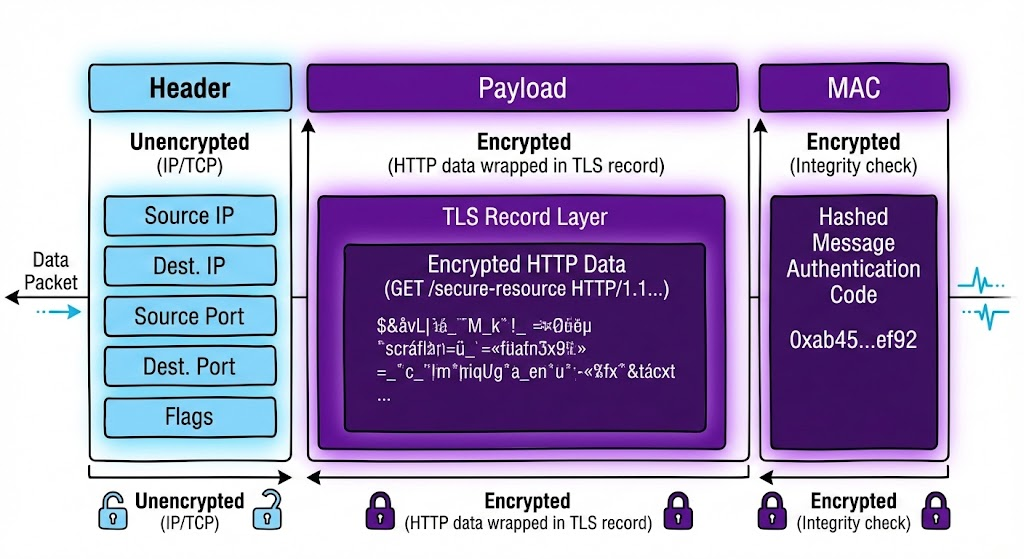
Data Packet Diagram
Exam Style Questions
Short Answer Questions (5)
1. Explain the role of a Nonce in cryptographic protocols and describe how it helps mitigate a specific attack.
Answer: A Nonce is a “number used once” that guarantees the freshness of a message. Nonces are often implemented as random numbers or sequence numbers and are required to assure the recipient that a message is not a replay of an old message observed by an attacker. A nonce is used to protect against replay attacks, where an adversary intercepts a valid message (such as an authentication token or key establishment parameters) and uses it later to impersonate the original sender or gain unauthorized access. To prevent this, a nonce is typically generated and sent by one party (the challenger) and subsequently returned by the other party (the respondent) to prove that the returned message was freshly generated in response to the challenge.
2. A Cipher Suite name, such as TLS_ECDHE_RSA_WITH_AES_128_GCM_SHA256, specifies four primary algorithmic functions. Identify these four types of algorithms and briefly state their purpose in the context of securing a connection.
Answer: A cipher suite defines the set of algorithms used to secure a network connection, typically including:
- Key Exchange Algorithm (e.g., ECDHE): Used to exchange or agree upon a session key between two devices securely.
- Authentication/Digital Signature Algorithm (e.g., RSA): Used to authenticate the server (and optionally the client) during the handshake, ensuring identity validation.
- Bulk Encryption Algorithm (e.g., AES): Used to encrypt the actual application data being sent, ensuring confidentiality.
- Message Authentication Code (MAC) Algorithm (e.g., SHA256/GCM): Used to provide data integrity checks, ensuring the transmitted data has not been altered in transit. In modern TLS (1.3), encryption and integrity are combined using Authenticated Encryption with Associated Data (AEAD) schemes like AES-GCM.
3. Explain the fundamental rationale for why the TLS handshake uses asymmetric cryptography (Public/Private Keys) initially but switches to symmetric cryptography (Session Keys) for the bulk of application data transfer.
Answer: The TLS protocol uses a two-level key concept. The initial phase uses asymmetric cryptography (Public/Private Keys) primarily because it solves the key distribution problem, enabling two parties who have never communicated to exchange a shared secret key over a public channel securely. The asymmetric keys (master keys) are long-lived and secret, used to authenticate the server and securely exchange the temporary secret key material.
The system then switches to symmetric cryptography using session keys (derived from the negotiated secret) for subsequent data transfer because symmetric-key encryption is significantly more efficient and faster than public-key encryption. Using session keys, which are short-lived, also provides increased security, as a compromise affects only that specific session and not the long-lived master key.
4. Describe the primary mechanism used by Certificate Authorities (CAs) to establish trust in a server’s public key during the TLS handshake, referencing the concept of a certificate chain.
Answer: The primary mechanism relies on the client implicitly trusting a list of Root CA Certificates (known as “trust anchors”) that are pre-installed in the browser or operating system. When a server sends its digital certificate during the handshake, it usually provides a certificate chain, which is an ordered list of certificates starting with the server’s certificate and ending with a Root CA Certificate. The client verifies the server’s public key by performing the following:
- The client verifies the digital signature on the server’s certificate using the public key of the issuing Intermediate CA.
- This process is followed recursively up the chain until a trusted Root CA certificate, signed by the CA itself, is reached and verified.
- Because the CA used its secret private key to sign the certificates, the client is convinced the public key truly belongs to the server and not an attacker, preventing impersonation.
5. What is the fundamental difference in latency between a full TLS 1.2 handshake and a full TLS 1.3 handshake, and how does TLS 1.3 achieve this performance improvement?
Answer: A full TLS 1.2 handshake typically requires two round trips (2-RTT) between the client and server before application data transfer can begin. TLS 1.3 reduces the standard handshake to one round trip (1-RTT).
TLS 1.3 achieves this by:
- Client Guessing: The client sends its key exchange parameters (needed for calculating the PreMaster Secret) in the initial
ClientHellomessage, essentially guessing the server’s preferred key exchange method. - Server Response: If the client guesses correctly, the server can send its public key, the chosen cipher suite, its certificate, and the
Finishedmessage all in its singleServerHelloresponse, significantly accelerating the setup. - Mandatory PFS: Since TLS 1.3 mandates ephemeral key exchange (like DHE/ECDHE), it eliminates negotiation steps related to static key exchange methods.
Scenario-Based Long-Form Questions (2)
1. Protocol Vulnerability and Modern Mitigation
A security team discovers that their legacy web application still supports TLS 1.0 and CBC-based cipher suites. The security audit identifies that the application is potentially vulnerable to both the BEAST and POODLE attacks due to their dependence on the MAC-then-encrypt structure and padding weaknesses.
Analyze why the MAC-then-encrypt approach used in TLS 1.2 and earlier (and SSL 3.0) facilitates padding oracle attacks like POODLE, and contrast this with the architecture and mandatory cryptographic features of TLS 1.3 that effectively mitigate these and similar attacks.
Answer: The MAC-then-encrypt approach used in SSL/TLS protocols before version 1.3 (where the Message Authentication Code and padding are applied, and the whole result is then encrypted) created critical vulnerabilities exploited by attacks like BEAST and POODLE.
Vulnerability of MAC-then-Encrypt (and CBC Mode):
- Order of Operations: In the MAC-then-encrypt scheme, the integrity check (MAC verification) happens after the decryption and padding check on the server side. In the case of CBC mode, the decryption process requires checking padding validity.
- Padding Oracle Leakage (POODLE): The POODLE attack specifically exploited flaws in SSL 3.0’s padding implementation where most padding bytes were ignored. By crafting altered ciphertexts and observing whether the server rejected the request due to an incorrect padding format versus an incorrect MAC, an attacker could create a “padding oracle”. The server’s rejection behavior (or timing difference, as exploited in similar attacks) effectively leaked information about the decrypted padding state, allowing the attacker to iteratively decipher one byte of plaintext per 256 attempts on average.
- BEAST Exploitation: The BEAST attack similarly capitalized on weaknesses in CBC mode initialization vectors (IVs) in SSLv3 and TLS 1.0, where the IV for a new record was derived from the last block of the previous record. This predictability, combined with the MAC-then-encrypt structure, allowed an attacker who could inject plaintext to manipulate the encryption machine into a decryption oracle.
Mitigation through TLS 1.3 Architecture:
TLS 1.3 effectively eliminates these vulnerabilities by removing the problematic architectural elements and mandating stronger cryptography.
- Removal of Insecure Ciphers and Modes: TLS 1.3 completely drops support for CBC mode ciphers, which were the target of BEAST, POODLE, and Lucky 13 attacks.
- Mandatory Authenticated Encryption (AEAD): TLS 1.3 requires the use of AEAD schemes (Authenticated Encryption with Associated Data), such as AES-GCM or ChaCha20-Poly1305. AEAD combines confidentiality and integrity simultaneously. This inherently enforces an encrypt-then-MAC model, ensuring that faulty packets are rejected immediately by the integrity check before any padding checks occur, thereby eliminating padding oracles.
- Removal of Compression: TLS 1.3 removed support for TLS compression entirely, mitigating CRIME and BREACH attacks, which relied on observing the length leakage caused by compression.
- Mandatory Perfect Forward Secrecy (PFS): TLS 1.3 enforces the use of ephemeral key exchanges (DHE/ECDHE) for all sessions. This means that even if a padding oracle attack were to compromise a current session, that compromise would not allow the attacker to decrypt past recorded traffic, as the long-term private key is never used to encrypt the session secret.
2. Key Management in Distributed Systems: Comparing Security Models
Alice and Bob need to securely establish a shared key () over an insecure network. They consider two different models:
Model A: Using a Trusted Third Party (TTP) like Sam (similar to Kerberos/Needham-Schroeder) who shares a secret key with both Alice () and Bob ().
Model B: Using an unauthenticated Key Exchange protocol without a TTP (like basic Diffie-Hellman).
For each model, identify a major attack vector associated with the model’s structure, and describe the mechanism necessary to ensure the fundamental security property of mutual authentication and session key agreement, assuming the adversary is a Dolev-Yao adversary.
Answer:
A Dolev-Yao adversary is one who controls the entire network, capable of eavesdropping on all messages, intercepting them, sending modified messages under any sender name, and constructing new messages from available information.
| Model | Major Attack Vector | Mechanism to Ensure Mutual Authentication & Key Agreement |
|---|---|---|
| Model A: Trusted Third Party (TTP) (e.g., Needham-Schroeder, Kerberos) | Replay Attack or Impersonation Attack. The primary structural weakness is ensuring key freshness and agreement. For example, in the original Needham-Schroeder protocol, an old session key (known to an adversary, Charlie) could be replayed to establish a session where Bob believes he is talking to Alice, but is actually using a compromised key. | TTP protocols overcome this by ensuring the exchange includes nonces or timestamps to prove freshness, and including the names of the communicating partners to ensure agreement on the identity. Protocols like the improved Needham-Schroeder and Kerberos use session keys () generated by Sam, encrypted for both parties, and include nonces or timestamps to validate freshness and prevent replays. |
| Model B: Unauthenticated Key Exchange (e.g., Basic Diffie-Hellman) | Man-in-the-Middle (MITM) Attack. Since basic Diffie-Hellman resists only passive adversaries (eavesdroppers), an active Dolev-Yao adversary (Eve) can intercept the public key shares (, ) exchanged by Alice and Bob. Eve establishes separate secret keys with each party ( with Alice, with Bob) by substituting her own public key () into the exchange, leading Alice to believe she is talking to Bob, and Bob to believe he is talking to Alice. | Unauthenticated protocols must be combined with digital signatures to ensure authenticity. Authenticated Diffie-Hellman protocols (like DHE/ECDHE used in TLS) achieve this by requiring the parties to use their long-term private keys to digitally sign the ephemeral public key shares ( and ) exchanged. This allows the recipient to verify the sender’s identity and detect any tampering by an intermediary. Protocols like the Station-to-Station (STS) protocol provide mutual authentication and key establishment by combining DH key agreement with signatures. |